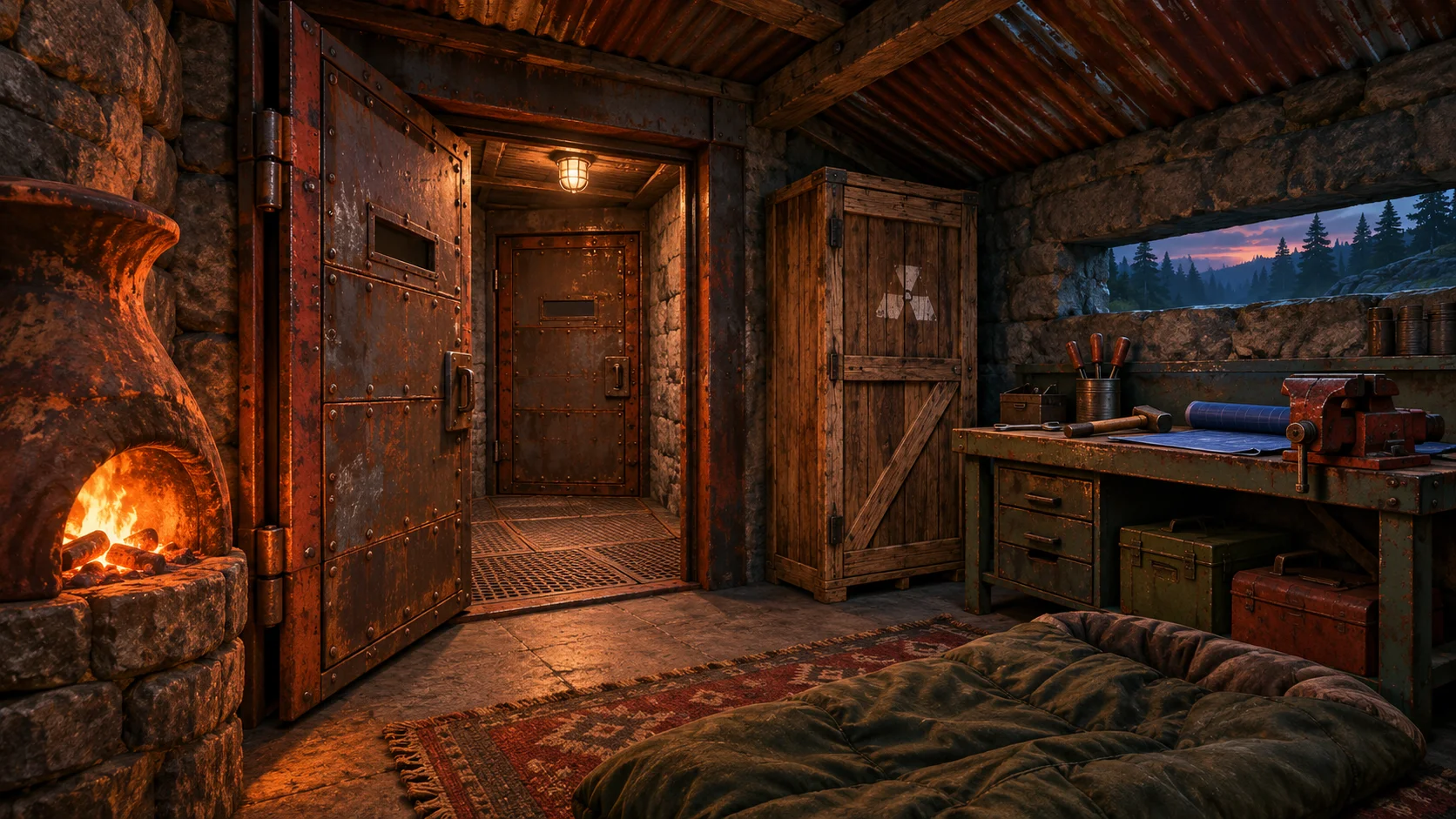
Mark four squares before building
Imagine two foundation rows: A–B at the front and C–D behind. These are four connected square foundations, not a requirement to create four separate rooms. Provisionally use the front edge of A for entry, B for work and the rear C–D area for storage, cupboard and recovery.
Place the footprint on a build server first. Check ground height, the outside approach and room for expansion. If a slope or neighboring construction already obstructs the entrance, changing the location is easier before upgrading walls and moving all your belongings.
Design the door sequence
Write out the route: outside, an intermediate airlock, the edge of A, the working area and inner storage. Doors should let you close exterior access before opening the next stage. Choose the airlock shape and door swing through testing, not automatically from the 2×2 outline.
Walk in and out with an empty inventory. Then have a teammate wait outside. Can they see the cupboard, follow you inside or pass through two doors left open because turning is awkward? Correct the problem before placing important supplies.
Fit the essentials without blocking movement
Start with the cupboard, respawn point and basic storage, checking access to each. Ordinary movement with doors open should not require repeatedly picking up furniture. C–D describes functional areas, not a promise that every possible item combination fits without testing.
Read the actual upkeep in the cupboard. Recheck after upgrading or expanding. Building privilege does not remove threats from entrances, ladders and exposed angles. A small footprint alone does not guarantee cheap upkeep or a difficult raid.
Expand from a working core
Choose a direction for more storage, a workstation or another defensive layer. Avoid placing the only important object across the future route. After every change, repeat the door routine and confirm that the cupboard and respawn point remain accessible.
RustGansh’s first lesson includes building, visibility and testing on a training server. It is a related lesson, not footage reproducing this exact 2×2 concept. Test your own version, keep the arrangement that works, then transfer it to the main server.
Before you leave
- Use four connected squares in an A–B / C–D footprint.
- Close outside access before opening the next door.
- Keep cupboard, respawn and storage accessible.
- Reserve one direction for expansion.
 Learning to build in Rust: peeks, electricity and a bunker — lesson 1